
2KWIK2C
Well-known member
Yes all of it to keep factory alignment.With that BDS 6 inch kit, didn't that include lowering the front differential?
Yes all of it to keep factory alignment.With that BDS 6 inch kit, didn't that include lowering the front differential?

Makes sense.Yes all of it to keep factory alignment.

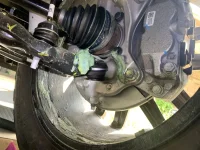
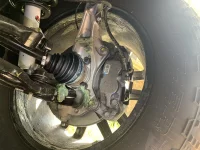
That part that I'm not understanding is the correlation between the leveling kits and the vibration in 4 Auto. Why is there a vibration? Is it because the cv axles aren't long enough and causing tension on components in the diff? Based on the info I've found 3rd party, the Trail Boss cv axles are slightly shorter (24.69" vs 24.84" = 3.81mm) than non-Trail Boss cv axles. Did GM possibly experience the same vibration when testing the Trail Boss with the axles all other trucks come with from the factory? NAPA's supplier seems to be a company called Trakmotive. They provided all the same specs the NAPA posted on its website. Not only are they making the OE replacement axles, but also those "lifted truck axles" I shared previously. I might be reaching out to them.The GM lift is a not a spacer lift, its just a longer shock. The longer CV's are so that the CV doesn't pull out, or cause damage to the transfer case, when the suspension is at maximum articulation.
That being said, I have yet to see a Z71, even with 4"+ of lift, break a CV. I have seen busted UCA's, but I have yet to see a single broken CV on non TB Z71's, leaving me wondering if the TB CV is really necessary at all.

With 35s I'm still spinning tires under light acceleration on wet roads. I don't have a lift. Just want to make sure I'm not damaging my truck if I install the ReadyLift 2" SST kit and choose to use 4 auto because of wet roads. It rains quite a bit in Florida compared to San Diego, CA.Here’s what I know. I have a 2in ReadyLift kit with 34in tires. I have used 4wd auto up to 50 mph in snow/ice conditions only with zero problems.

The CV length is constant regardless of 4WD mode, so if it were a CV length issue, it would be present in all modes. Since the issue is only present in 4Auto, then by default, that eliminates CV length as being the issue.Why is there a vibration? Is it because the cv axles aren't long enough and causing tension on components in the diff?
So I agree. What I was told is it's with the torque management that's with the AWD mode. As we know, in AWD mode the system is distributing torque based on a predetermined/programmed criteria between the 4 wheels. Its my understanding that the change in CV angles from leveling up the front beyond EO spec is causing just enough mild binding. That mild binding apparently is enough to "throw a curve ball" with the AWD modes ability to transfer torque. It thinks the front wheels have more traction, but as the truck rolls down the road and the suspension is flexing, that binding is quickly being relieved and then back out of spec/binding.The whole 4Auto issue has nothing to do with the reliability of the CV's. The two are unrelated, and just an assumed correlation between the two. There were issues with balance and harmonics in 4Auto for some reason and the drivability issues were noted while in 4Auto, but not 4Hi. The only difference between 4Auto and 4Hi is the automatic, and potentially constantly adjusting percentages of power transfer between the front and rear differentials as you drive over varied terrain. Again, not the CV's, or differentials at issue.
There is no difference in the function of the CV's or differentials when in 4Auto vs 4Hi vs 4Lo, they transfer forces from the transfer case into forward and rear motion, and that's it. Again, they perform no difference in function whether 4Lo, 4Hi, or 4Auto. Furthermore, although its obvious, your vehicle suspension dynamics DO NOT CHANGE based on the selection of 4Hi, 4Lo, or 4Auto, so there are no geometry changes and no functional changes occurring to the front end of the truck.
The only functional difference between 4Hi and 4Auto in our trucks occurs in the transfer case whiles it's distributing constantly variable drive force percentages to the front and rear differentials while in 4Auto.
The constant binding and relinquishment cycle would explain the presence of vibrations, or "out of balance/harmonics" issues that were reported. Thanks for the insight.So I agree. What I was told is it's with the torque management that's with the AWD mode. As we know, in AWD mode the system is distributing torque based on a predetermined/programmed criteria between the 4 wheels. Its my understanding that the change in CV angles from leveling up the front beyond EO spec is causing just enough mild binding. That mild binding apparently is enough to "throw a curve ball" with the AWD modes ability to transfer torque. It thinks the front wheels have more traction, but as the truck rolls down the road and the suspension is flexing, that binding is quickly being relieved and then back out of spec/binding.
So, theoretically, why wouldn't the CV axles NAPA sells for "lifted trucks" that I posted earlier not work? Their advertisement says cv axles are made to flex ~23°. These "lifted truck" axles flex ~46°. Seems like the binding issue may be alleviated?The constant binding and relinquishment cycle would explain the presence of vibrations, or "out of balance/harmonics" issues that were reported. Thanks for the insight.
I'm not sure to be honestSo, theoretically, why wouldn't the CV axles NAPA sells for "lifted trucks" that I posted earlier not work? Their advertisement says cv axles are made to flex ~23°. These "lifted truck" axles flex ~46°. Seems like the binding issue may be alleviated?